Openers · Sunnyside
Chain-Drive Opener Repair in Sunnyside
The chain in the detached garage went orange with rust over the winter, the links are stiff, and the opener strains and groans to pull the door up. By afternoon, once the garage warms, it behaves almost normally.
Chain-Drive Opener Repair
In plain words
Sometimes nothing is broken and the operator has simply forgotten where the door should stop. Travel limits tell it how far to run in each direction; force settings tell it how much effort is normal, so it can notice an obstruction. When limits drift, a door stops short of the floor, reverses at the bottom or opens partway. When force is set low, the door reverses for no reason; set high, it stops protecting anyone beneath it. A chain-drive repair resets both, by screw on older heads or learn buttons on newer ones, then proves the reversal with a block on the floor.
How the visit goesThe motor runs, you can hear it working, but the door never moves. When you look up, the sprocket on top of the head is barely turning, and there is a little drift of pale plastic dust on the cover.
Sunnyside
How the visit goes
Lifting the door before touching the drive
Every chain-drive repair starts with the operator unplugged and the red release pulled so the door is free of the trolley. The technician then lifts the door by hand. It should rise with modest effort, stay where it is left about a metre off the floor and settle gently at the top. A door that is heavy in the hands or drifts down is telling the technician that the springs, not the chain, are behind the strain, and that a stripped gear or a jumping chain was the symptom rather than the cause. Sorting the door out first is what gives a repaired drive a long life instead of a second failure.
Resetting travel and force
With the drive mechanically sound, the operator is taught the door again. On older heads, the up and down limit screws are turned with a flat screwdriver, each full turn moving the stop about 5 cm, until the door meets the floor with the seal lightly compressed and opens to full height without the trolley reaching the bolt. Force is set to the lightest level that moves the door reliably through a full cycle in the garage's normal temperature. Newer heads run a learn cycle from buttons on the back and measure both for themselves. The operator is then cycled several times to confirm the settings hold.
Balance is what protects the new gear
The drive gear that was replaced can wear out when it is asked to lift more than the chain should carry, though binding or wear elsewhere in the drive can share the blame. Keeping the load honest starts with the door's balance. Each season, with the door closed, pull the red release, lift the door by hand to about a metre and let go; it should stay put. If it sinks or creeps upward, the springs have drifted and a spring adjustment is due before the operator starts working harder to compensate. Reconnect by running the operator until the trolley picks up the arm. This one check does more for the gearbox than anything else you can do.
Chain-Drive Opener Repair
In the van
- Trolley release lever
- Cold-rated garage door lubricant
- White lithium grease
- Sprocket and shaft assembly
- Drive gear and worm gear kit
What affects the quote
Same fees day, night or weekend
1Ceiling height and access
A head hung from a high or cathedral ceiling, or a rail boxed in by storage racks, a lift or ductwork, takes longer to reach and work on than one under a standard joist with a clear floor.
2Door hardware quieted at the same time
Nylon rollers, new hinges or a vibration isolator chosen to quiet the door and the ceiling alongside the drive repair are optional items listed on their own.
3The gear kit for your model
Drive gear, worm gear and sprocket shaft assemblies are made to fit a particular head, and the kit for an older or less common unit is a different item from the one for a current model.
Chain-Drive Opener Repair: questions
How much slack should the chain have?
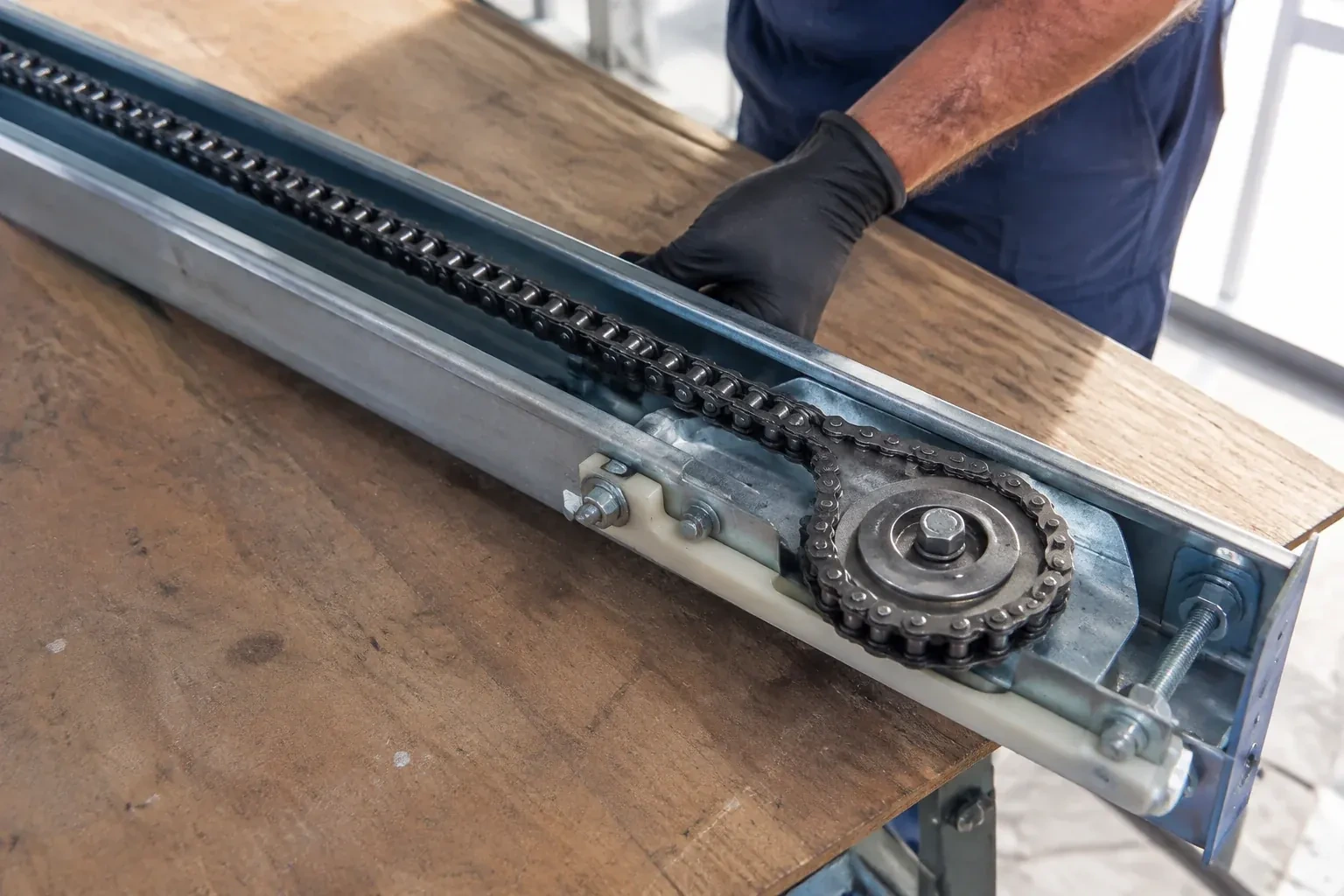
It is a measurement, taken with the door closed and disconnected from the trolley. At the middle of the rail the chain should sit at the height the opener's own manual specifies for its rail shape, since the figure is not the same across makes. The two nuts on the trolley set and lock it. With the door reconnected and closed, some droop appears; that is expected as long as the measurement returns when the door is open.
Is a chain drive supposed to be this noisy?
A chain drive has a steady mechanical sound that a belt drive lacks, and that much is normal. What is not normal is change: a slap along the rail from a loose chain, a clack at one spot from a worn sprocket tooth, grinding from the head as a gear wears, or a rattle from hangers or a header bracket that have loosened. Each of those has a fix, and a repaired chain drive should sound the way it did when it was new.
Why does the door touch the floor and then go back up?
The operator believes it has hit something. Either the down travel limit is set a little too far, so the door is pressing into the floor past its stopping point, or the closing force is set too low for the door's current weight, so the last push reads as an obstruction. A seal frozen to the slab causes the same reversal in winter. The technician adjusts the limit or the force, in that order, and re-tests the reversal afterwards.
Openers & Access
Chain-Drive Opener Repair near you
The garage door services we bring to Sunnyside fall into four groups: repair and maintenance for doors that are sticking or noisy; springs and lifting hardware; openers, remotes and access; and new door installation or upgrade for homes and businesses that are ready for a change.